How Lula went from 2.2 million votes behind in the first round to winning by 4.4 million: the result, municipal maps, turnout, mobilization and social media, Meta, the debates, the polls and a first measurement of the voting extension until 7 p.m. Reading of October 26, 2026, with the complete TSE count.
Each section carries labels stating where its numbers come from: calculatedcomputed by Henrichs from official data; anyone can redo it. estimatedofficial data with an assumption along the way, stated in the section. reportedinformation from the press or third parties, with the source cited. interpretiveHenrichs' reading of the data, not a measurement.
By Pedro Paulo Henrichs Neto, founder and CEO of Henrichs Consultoria · Oct 26, 2026
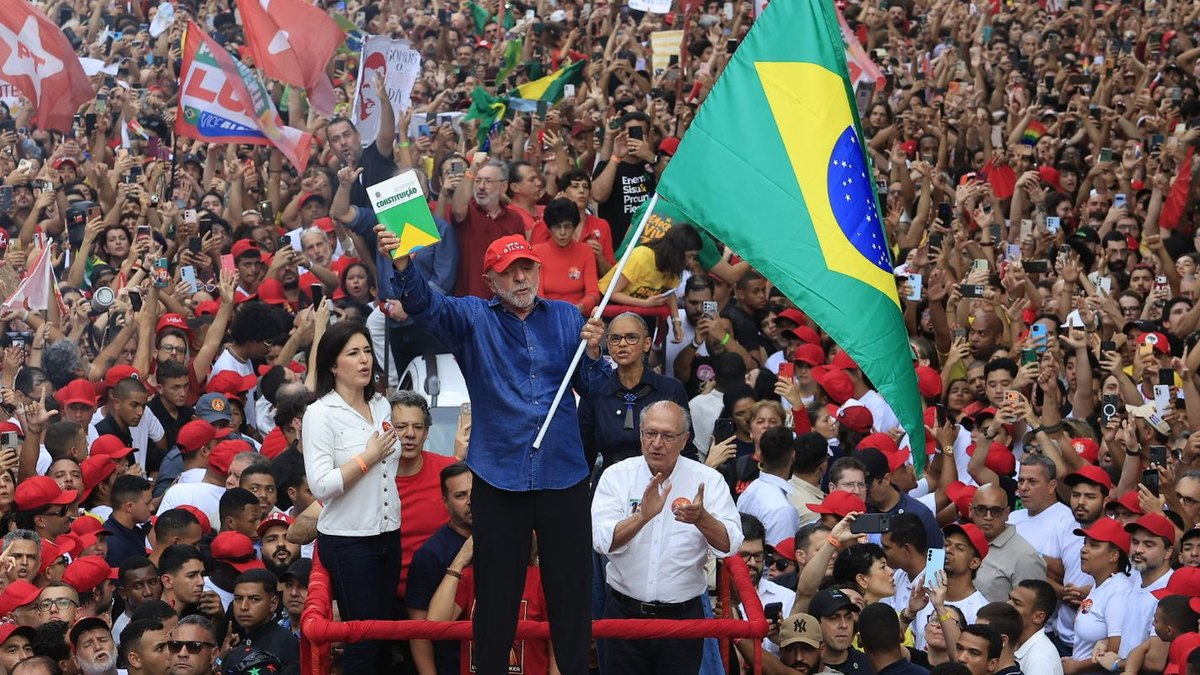
Photo: Paulo Pinto/Agência Brasil. Lula closes the runoff campaign on Avenida Paulista, October 24, 2026.
Founder and CEO of Henrichs Consultoria, responsible for this analysis
20+
years working with the Brazilian federal government
Pedro Paulo Henrichs Neto is the founder and CEO of Henrichs Consultoria, a Brasília firm specializing in institutional and government relations, monitoring of Congress and the federal Executive, and public-data intelligence.
This analysis combines that experience with a reading of the official TSE results, municipality by municipality and ballot report by ballot report, of the registered polls and of press coverage.
Public management
He was chief of staff to a federal deputy in the Chamber of Deputies (2018) and undersecretary for Social Participation of the Federal District Government (2011 to 2013).
Financial system
He began his career at Banco do Brasil as a clerk (2004 to 2006) and was a technical and political adviser to the Brasília Bank Workers’ Union (2006 to 2010).
Elections and international work
He has been an accredited international electoral observer in more than 20 elections in the Americas, Europe and Asia, and chaired the BRICS Youth Forum (2014 to 2016).
Education
He holds a degree in Public Management from IESB and is a master’s student in Political Science and International Relations at IDP. In 2026 he completed the international program in innovation, leadership, compliance and risk management at the Sorbonne School of Management (Université Paris 1 Panthéon-Sorbonne).
Data and technology
Henrichs Consultoria builds its own legislative-monitoring systems and public-data intelligence dashboards, which were used to produce this analysis.
Responsible: Pedro Paulo Henrichs Neto · Henrichs Consultoria · henrichsconsultoria.com.br · contatoconsultoria@proton.me
Summarycalculated
Lula swung 6.66 million votes in three weeks and is the first to win after losing the first round
It was −2.22 M in the first round. A 6.66 M gain in the margin.
New votes
73.6%
Lula's share of the 14.1 M votes that entered the race (+10.38 M against +3.72 M).
Abstention
19.22%
It was 21.08%. About 2.96 M more voters, the lowest runoff abstention since 2006.
Where. Lula grew in all 27 states and in all 27 capitals. Minas Gerais was the only state that flipped (50.43%). The Southeast went from −5.66 M to −2.81 M; the Northeast, from +11.10 M to +13.65 M.
How. Third-party votes, turnout and valid votes, driven by mobilization: a WhatsApp channel with more than 10 M followers, voters travelling to vote and abstention falling above all in the urban Southeast.
What comes next. Flávio does not recognize the result and announced a request for annulment, centered on the extension of voting until 7 p.m. The government starts with the PL holding the largest caucus in the Chamber and in the Senate.
I. The resultcalculated
The score, round by round
1st round (4/10)
Runoff (25/10)
Change
Lula
53,879,538 (45.16%)
64,256,232 (51.79%)
+10,376,694
Flávio Bolsonaro
56,104,503 (47.03%)
59,826,041 (48.21%)
+3,721,538
Other candidates
9,316,747
–
−9,316,747
Blank and null
5,975,047
4,153,801
−1,821,246
Turnout
125,275,835 (78.92%)
128,236,074 (80.78%)
+2,960,239
Abstention
33,469,244 (21.08%)
30,509,005 (19.22%)
−2,960,239
Lula's margin
−2,224,965
+4,430,191
+6,655,156
Source: TSE, official result files, 100% of the 499,248 polling stations counted, including abroad.
Unprecedented. In the seven presidential races decided in two rounds since 1989, whoever led the first vote always won. Not this time.
Largest PT victory since 2010. The 4.43 M margin is double that of 2022 (2.14 M), and Lula's total, 64.26 M, is the highest ever received by a candidate in the country.
The count. Lula started ahead, Flávio took the lead early in the count and Lula regained it with about 48% of polling stations counted, never to lose it again. With 91.95% of stations counted, the victory was already mathematically certain.
I. The resultcalculated
An unprecedented comeback, with abstention going against the trend
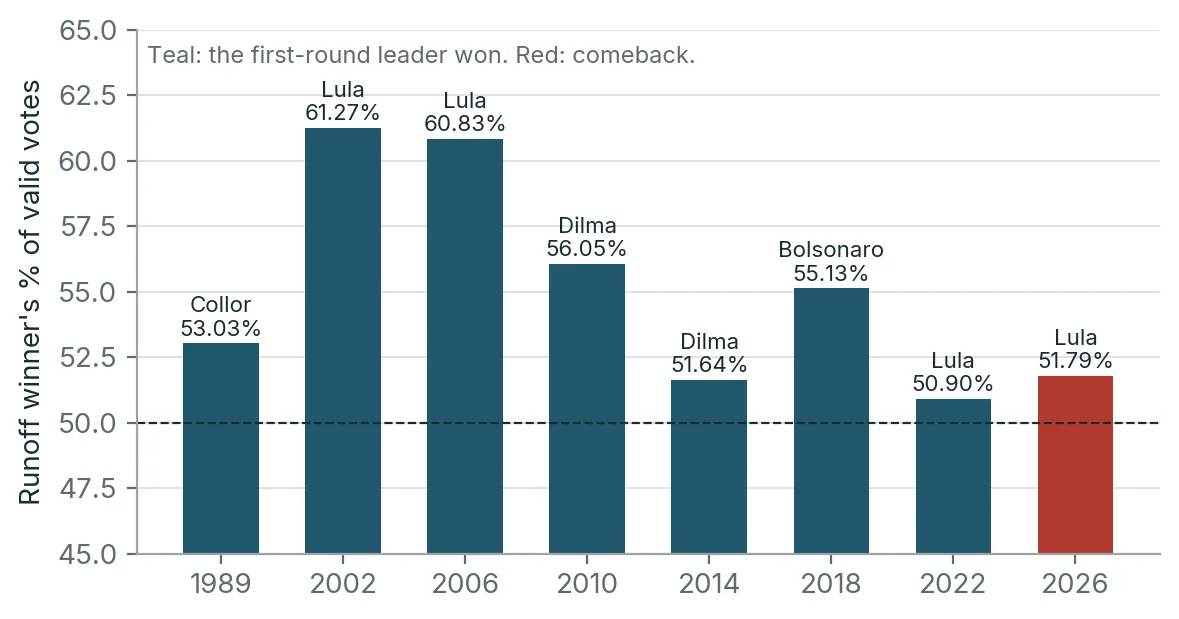
Valid votes of the runoff winner, 1989 to 2026 (TSE).
Eight runoffs, one comeback. From 1989 to 2022, whoever led the first vote took the presidential sash. In 2026, Flávio led with 47.03% and lost. Lula's margin (3.58 points) is larger than in 2022 (1.80) and than Dilma's in 2014 (3.28).
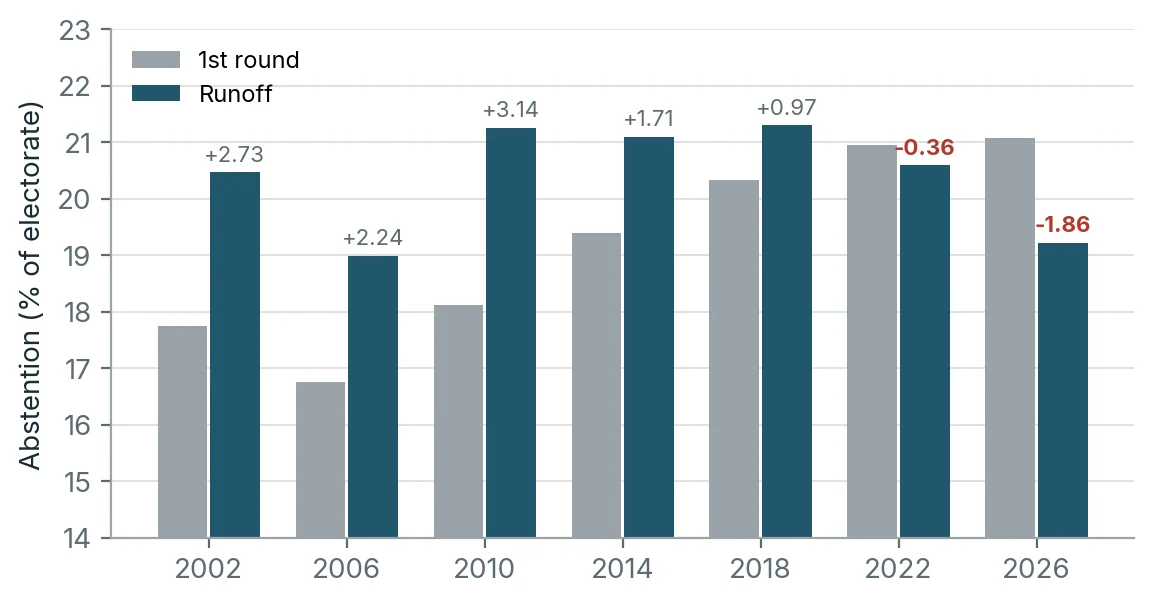
Abstention in the first round and runoff of presidential elections, 2002 to 2026 (TSE). Label: change between rounds.
The trend broke for good. Until 2018, the runoff always had more abstention than the first round, 1 to 3 points more. In 2022 it fell 0.36 point; in 2026, 1.86 points, the largest drop in the series and the first time the runoff came in below 20% since 2006.
II. The arithmetic of the comebackcalculatedestimated
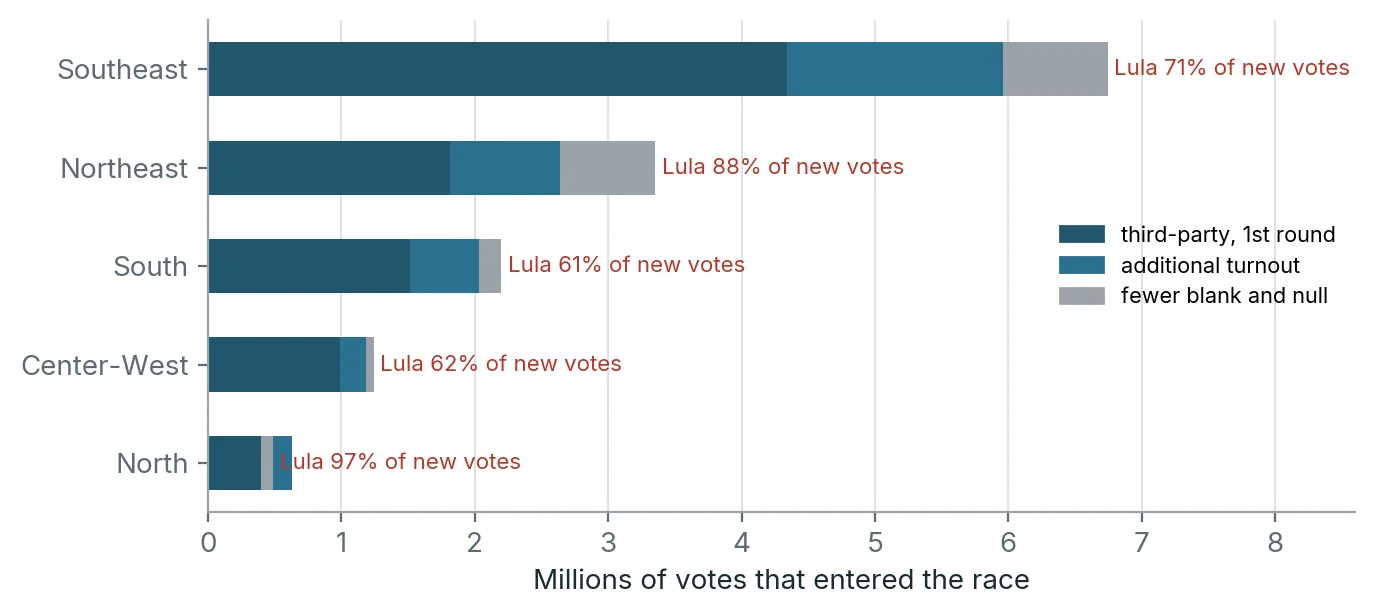
Where the 14.1 million votes that entered the race came from
Between rounds, Lula and Flávio together gained 14.10 M votes. The sum closes exactly with three sources: the 9.32 M given to the other candidates in the first round, 2.96 M voters who turned out and 1.82 M who stopped voting blank or null.
Of that total, Lula took 73.6%. On his own he added more new votes (10.38 M) than all eliminated candidates had received combined.
Who got what (estimate). An ecological model over the 5,570 municipalities attributes to Lula about 60% of the third-party votes and about 66% of the new turnout. It is an association between territories, not a measured individual transfer, and serves as an order of magnitude.
What this means. The comeback did not come from a single source. Without third-party votes, Lula would not have tied; without turnout and the drop in invalid votes, he would not have opened 4.4 M. The formal endorsements of Flávio in the runoff (Republicanos, Novo, União Brasil, PP and Tarcísio de Freitas) did not convert into votes in the same proportion.
Compared with the eve. The X-Ray's national study estimated that Lula was short about 2 million net votes from those who had stayed home or annulled. 4.78 M more votes came between turnout and fewer invalid votes.
II. The arithmetic of the comebackcalculated
The make-up of the new votes changes from region to region
Region
Third-party, 1st round
Additional voters
Fewer invalid votes
Lula + / Flávio + (thousand)
Southeast
4,343k
+1.61 M
788k
+4,800 / +1,945
Northeast
1,811k
+827k
716k
+2,956 / +398
South
1,514k
+519k
167k
+1,333 / +867
Center-West
988k
+199k
55k
+771 / +470
North
632k
−238k
94k
+474 / +14
Abroad
30k
+40k
1k
+43 / +28
Southeast: volume. It held 4.34 M of the 9.32 M third-party votes and 1.61 M additional voters appeared. Lula took 71% of what came in, against 29% for Flávio.
Northeast: almost everything to Lula. 88% of the region's new votes went to Lula; Flávio added only 0.40 M.
South and Center-West: more balanced. Flávio took about 4 in 10 new votes, enough to hold both regions but not to prevent the national comeback.
North: fewer people voting. Turnout fell by 238 thousand; Flávio practically stood still (+14 thousand) and Lula grew by 474 thousand.
Ecological model by region. The estimated share of third-party votes that went to Lula ranges from 40% in the South to 83% in the North (78% in the Northeast, 54% in the Southeast). For new voters the coefficient is close to or above 1, a sign that Lula also took votes from people who had backed Flávio, which the model cannot separate.
III. Territorycalculated
The runoff map: Lula in the North, Flávio in the Center-South
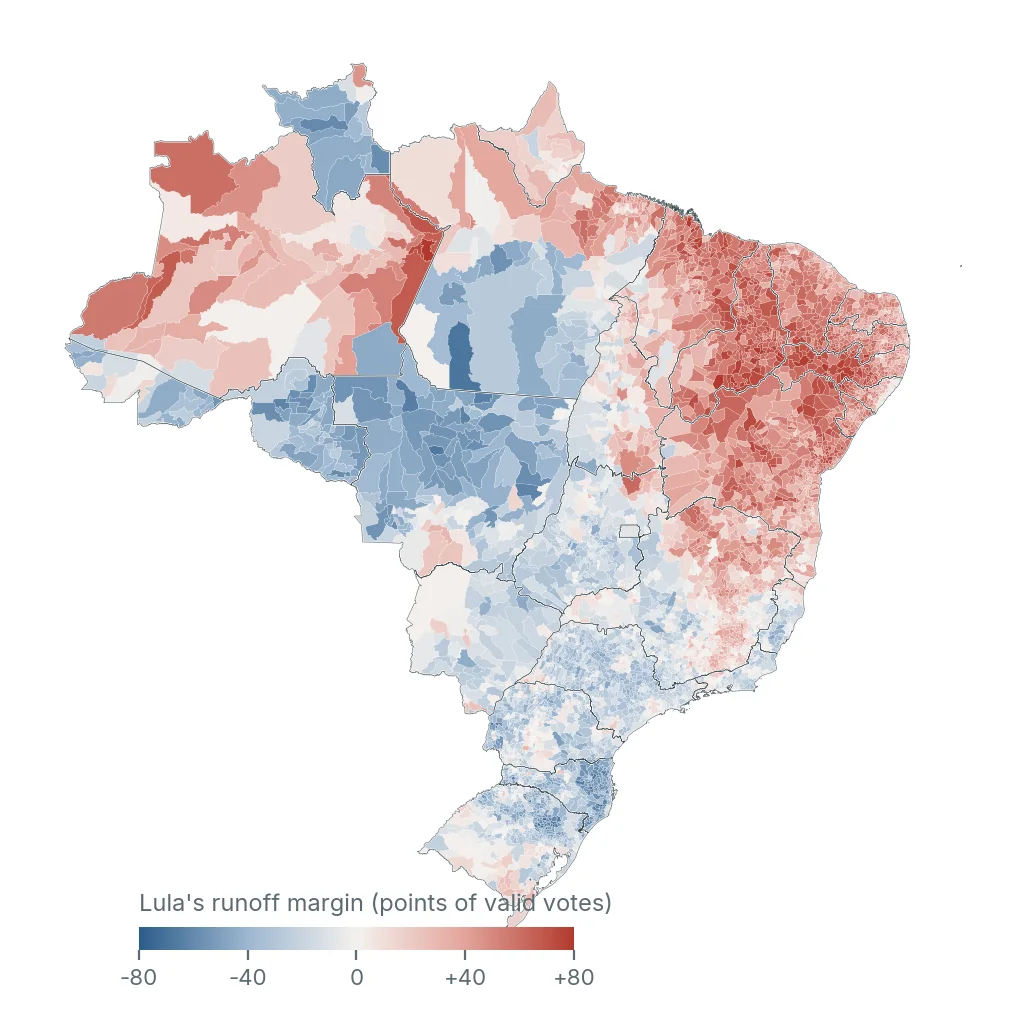
Two Brazils, with moving borders. Lula won in 2,875 municipalities and Flávio in 2,695. Red covers the entire Northeast (Lula won all 9 states, with 24.45 M votes against 10.80 M), Amazonas, Pará and Amapá; blue dominates the Center-West, Rondônia, Roraima, inland São Paulo and the South.
The transition belt. 903 municipalities ended with a margin below 10 points, the light-colored areas: 262 in Minas Gerais, 141 in São Paulo, 110 in Paraná, 91 in Rio Grande do Sul and 68 in Goiás. That is where the flips happened.
Extremes. Lula had a margin above 60 points in 530 municipalities (127 in Piauí, 93 in Bahia, 71 in Paraíba, 69 in Pernambuco); Flávio, in 71 (31 in Rio Grande do Sul and 28 in Santa Catarina).
III. Territorycalculated
Almost the whole country moved toward Lula
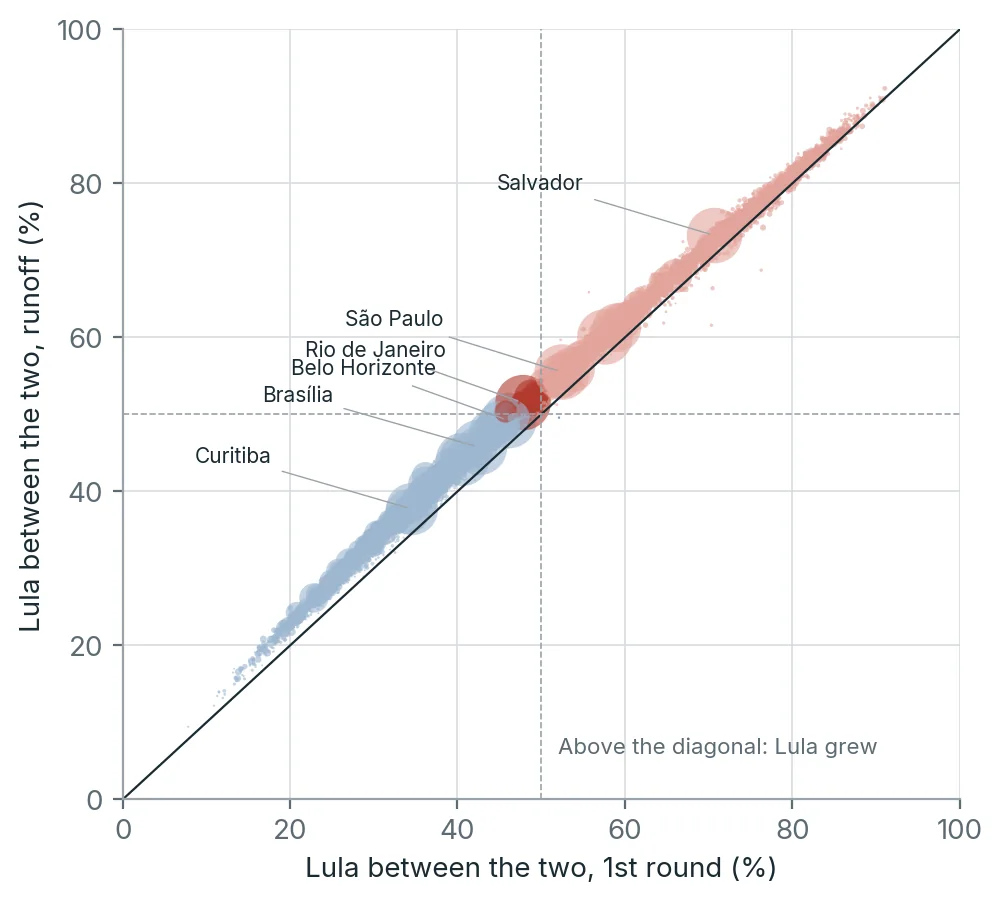
Each dot is a municipality, sized by electorate. Lula's share between the two candidates. Strong red: flips to Lula; strong blue: flip to Flávio.
Reading. The cloud sits entirely above the diagonal: Lula gained in valid votes in 5,567 of 5,570 municipalities. The gain was larger in the middle of the distribution (municipalities with 30% to 50% for Lula in the first round rose 3.5 to 3.8 points) and smaller in both sides' strongholds.
III. Territorycalculated
By state: Minas flipped, São Paulo gave the largest margin gain
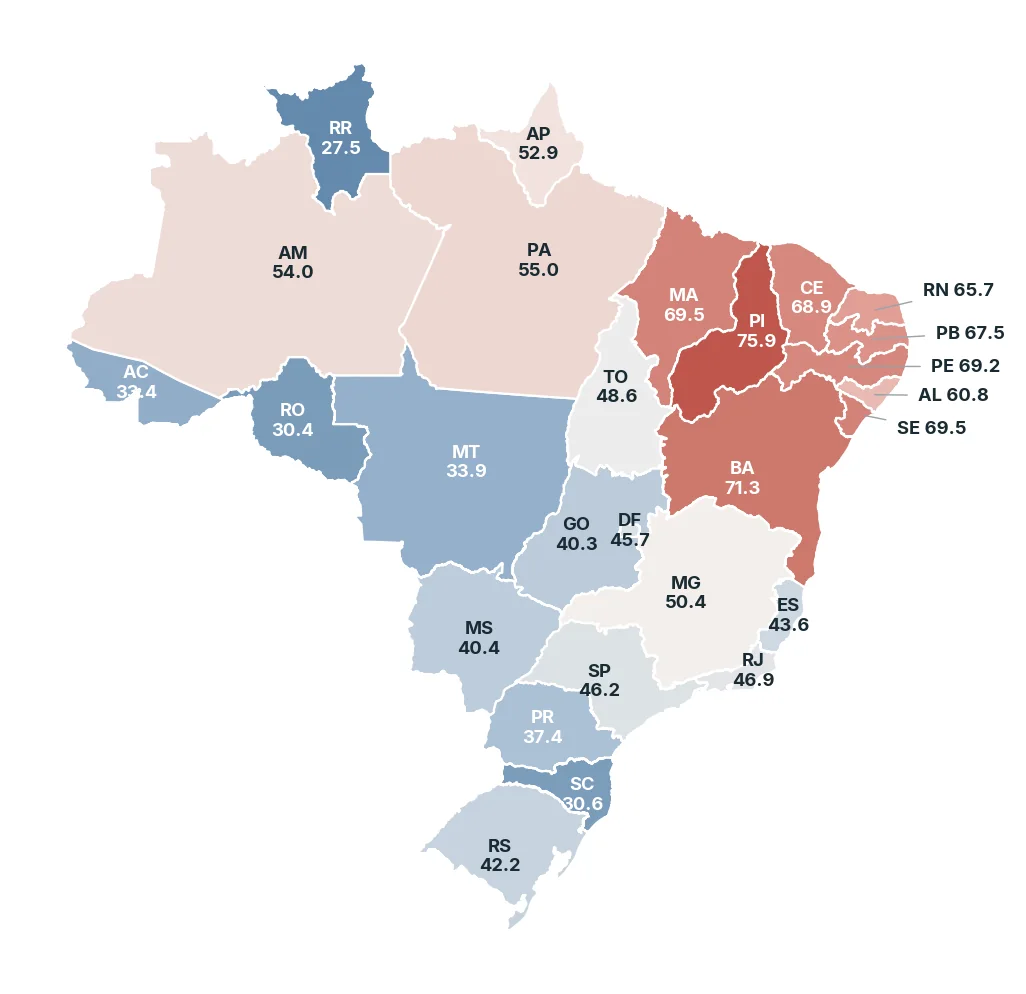
Lula's valid votes in the runoff, by state.
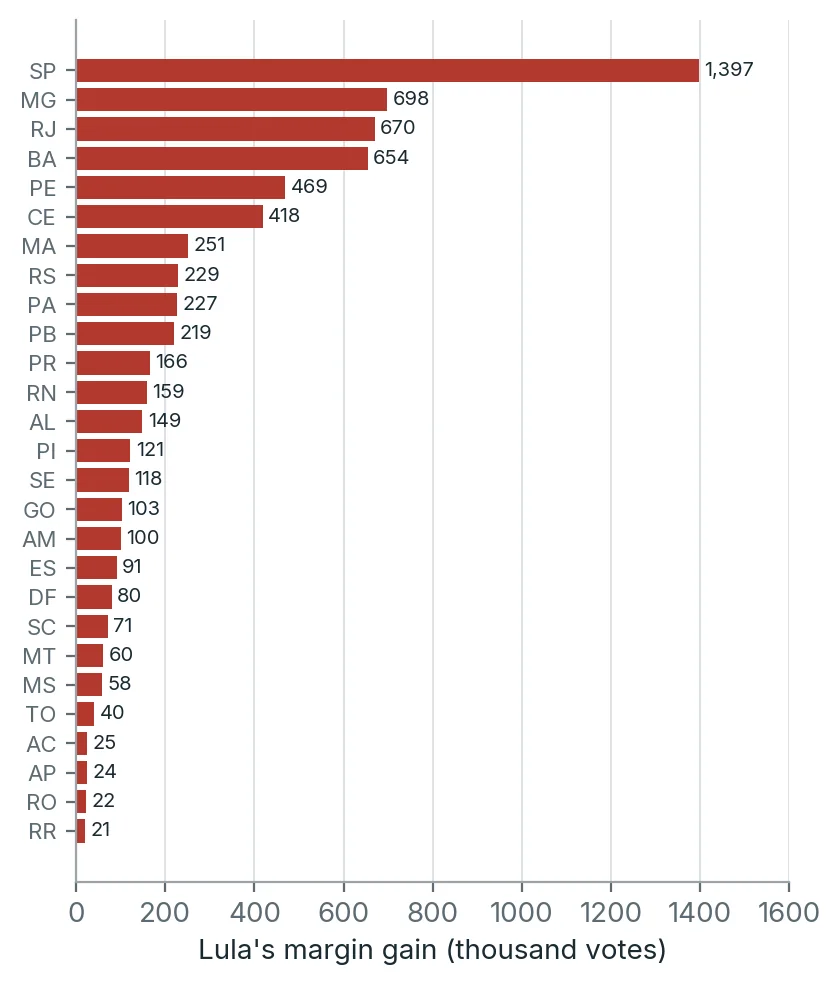
Gains in all 27. Lula gained margin in every state. São Paulo alone accounted for 1.40 M of the 6.66 M, more than the South and Center-West combined (0.77 M).
III. Wherecalculated
Lula grew in every state; Minas was the only one that flipped
Lula's valid votes. Hollow circle: first round (over all valid votes). Solid circle: runoff.
State tally. Flávio won 15 states in the first round and Lula 12. In the runoff, 14 to 13: Minas went to Lula (6,351,099 to 6,241,786).
Close calls. Tocantins (Lula 48.63%) and Amapá (52.88%, where Lula led the first round by 225 votes) were the tightest races outside Minas. Abroad, Lula had 53.86%.
Largest margin gains. São Paulo (+1.40 M), Minas Gerais (+0.70 M), Rio de Janeiro (+0.67 M), Bahia (+0.65 M) and Pernambuco (+0.47 M).
III. Wherecalculated
By region, the Southeast halved the deficit and the Northeast widened the lead
Lula's margin over Flávio, in millions of votes.
Region
Margin R1
Margin R2
Gain
Southeast
-5.66
-2.81
2.86
Northeast
11.10
13.65
2.56
South
-5.04
-4.58
0.47
Center-West
-2.17
-1.87
0.30
North
-0.46
0.00
0.46
Abroad
0.01
0.03
0.02
North, vote by vote. Lula won the region by 1,079 votes (5,024,626 to 5,023,547).
The Southeast decided. Of the 6.66 M margin gain, 2.86 M came from the Southeast and 2.56 M from the Northeast.
IV. Municipalities and capitalscalculated
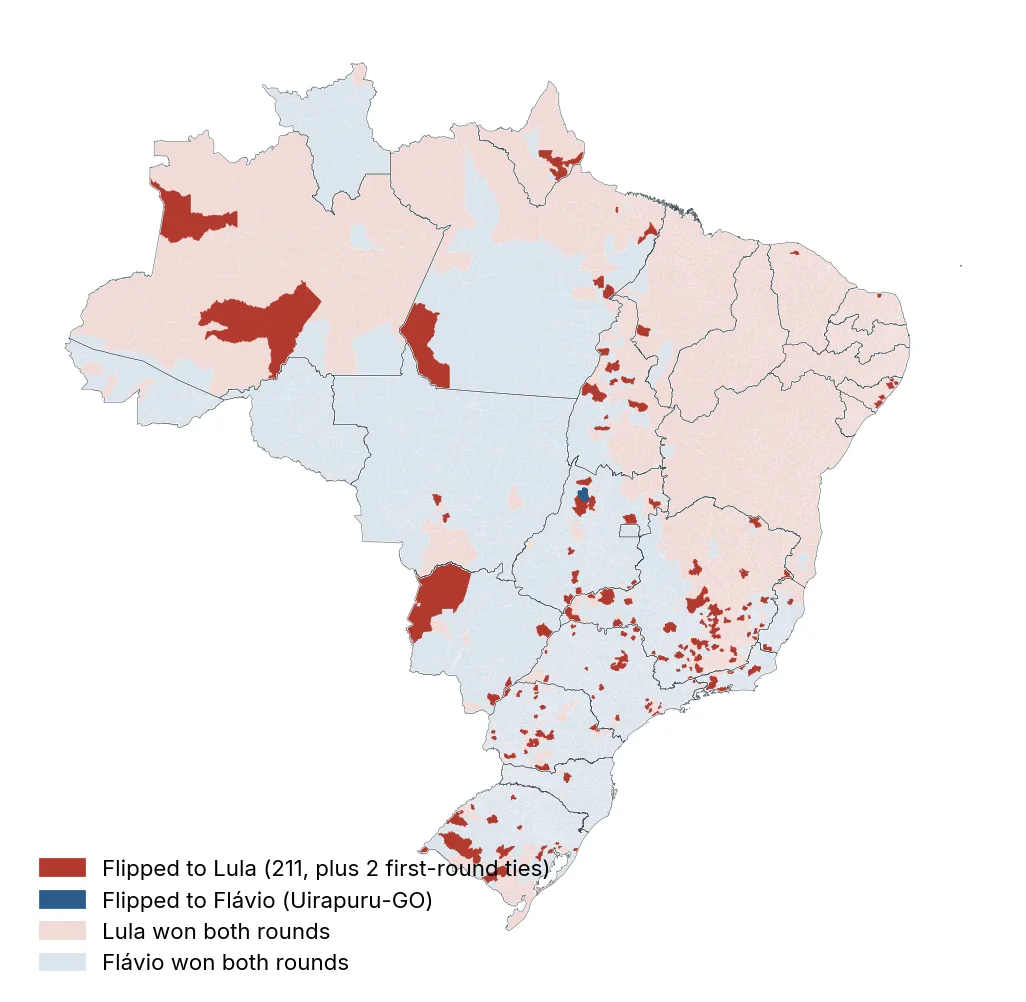
The map of the 211 flips
Where they cluster. Minas Gerais (76), São Paulo (32), Paraná (20), Rio Grande do Sul (19), Goiás (14) and Tocantins (11). In the North, the large patches on the map are vast, sparsely populated municipalities in Amazonas (Tapauá, Canutama, Japurá) and Pará (Jacareacanga); the real weight there lies in Ananindeua and Macapá.
Electoral weight. The 211 flips total 10.9 M eligible voters and include the city of Rio de Janeiro (3.7 M valid votes), Osasco, Ananindeua, Macapá and São Vicente, plus dozens of mid-sized cities. Together, they gave Lula a 0.55 M margin gain.
The exception. Uirapuru (GO), with 3.1 thousand voters, was the only municipality where Lula led in the first round (930 to 854) and lost the runoff (1,069 to 1,087).
IV. Municipalities and capitalscalculated
211 flips to Lula and one to Flávio
Flips to Lula
211
Municipalities where Flávio won the first round and Lula the runoff. Another 2 were tied in the first round and went to Lula (Trabiju-SP and Crixás do Tocantins-TO).
Flips to Flávio
1
Uirapuru (GO), where Lula had a 4.3-point lead between the two and lost by 0.8.
Flips by state
No.
Minas Gerais
76
São Paulo
32
Paraná
20
Rio Grande do Sul
19
Goiás
14
Other states (Tocantins 11, Rio de Janeiro 9 and others)
50
By region: Southeast 120, South 40, North 21, Center-West 20, Northeast 10.
Largest cities that flipped. Rio de Janeiro (−4.3 to +3.1 points), Osasco (−2.4 to +4.7), Ananindeua (−1.3 to +5.2), Macapá (−4.3 to +2.0) and São Vicente (−8.5 to +0.7). Margins over the two candidates' votes.
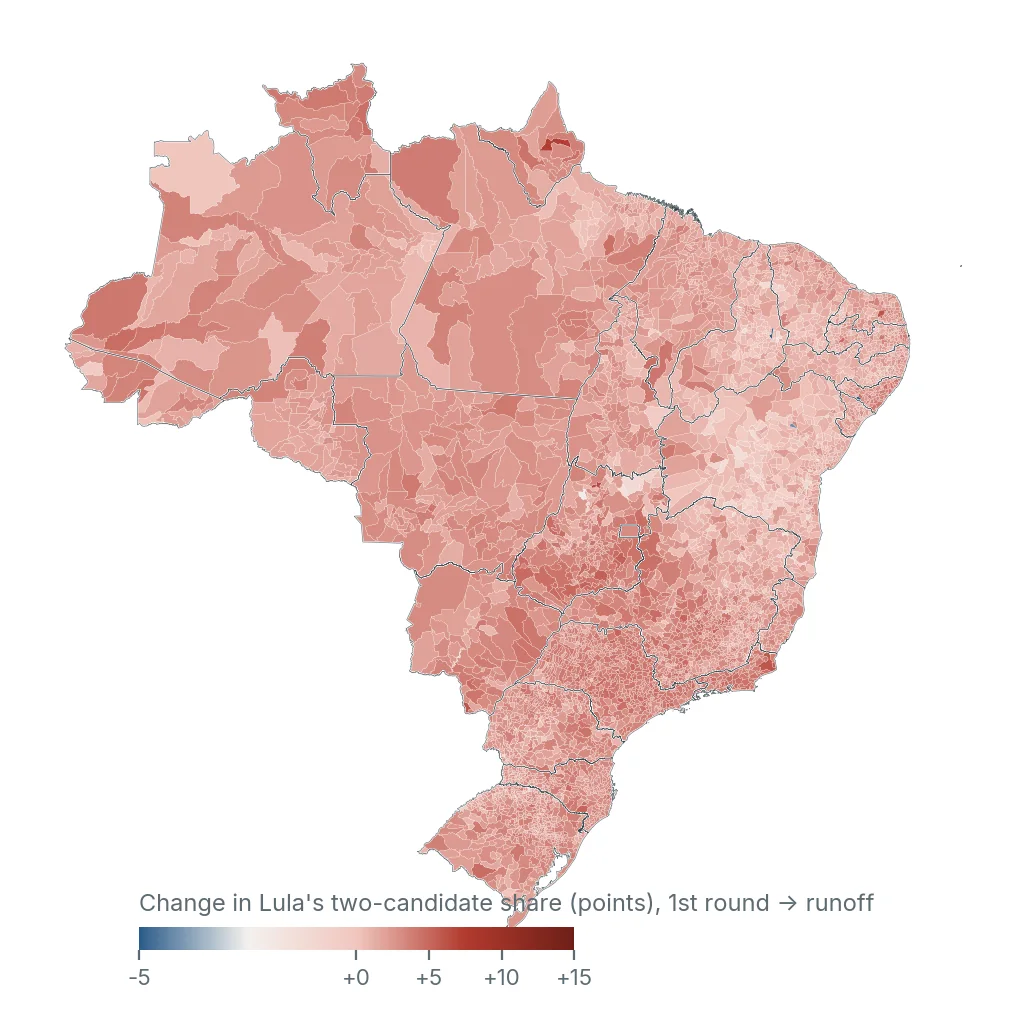
Almost the whole country moved the same way. The margin between the two improved for Lula in 5,411 of 5,570 municipalities (97.1%). Press tallies reach 5,385 (96.7%) using a different criterion.
All of Ceará. Morrinhos, the only municipality in Ceará that went to Flávio in the first round, flipped: Lula won all 184. Itabirito (MG) had the flip most cited by the press, from −5.2 to +5.0.
Swing cities. O Globo identified 495 municipalities that went to Bolsonaro in 2018, to Lula in 2022 and to Flávio in the first round, with 9.2 M voters; according to the newspaper, Lula flipped one in four of them.
IV. Municipalities and capitalscalculated
The 20 cities that gave Lula the most margin, and how the capitals moved
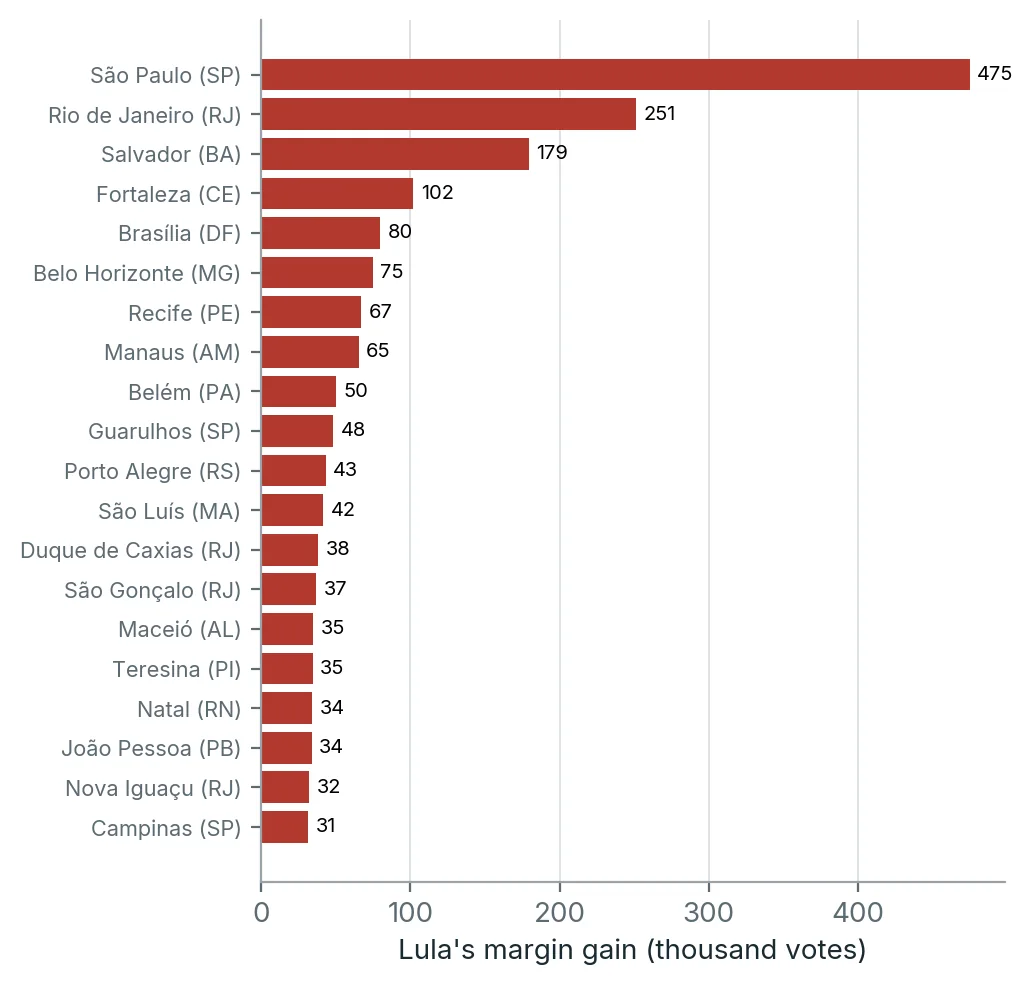
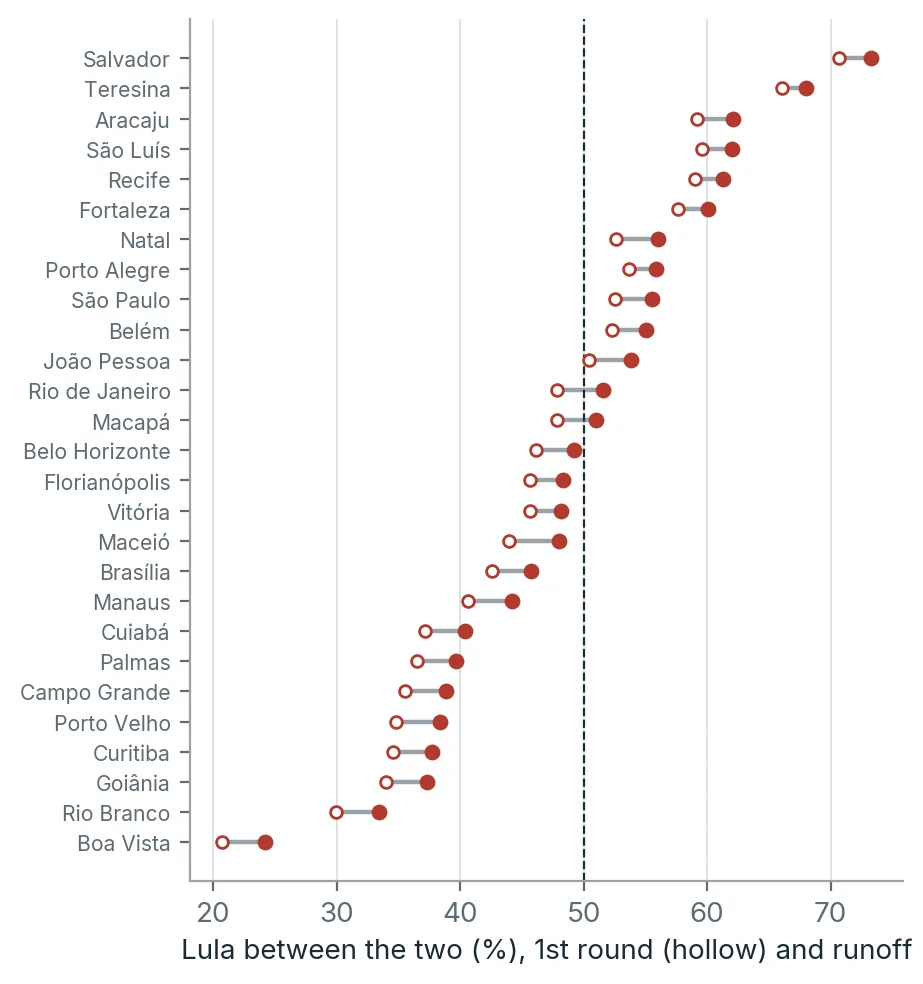
Left: margin gain (Lula − Flávio in the runoff minus the same in the first round), in thousand votes. Right: Lula's share between the two, first round (hollow) and runoff (solid).
IV. Municipalities and capitalscalculated
Lula grew in all 27 capitals; São Paulo alone gave a 475 thousand vote margin gain
Capital
Lula R1
Lula R2
Margin gain
São Paulo (SP)
46.6%
55.5%
+474,829
Rio de Janeiro (RJ)
43.9%
51.5%
+251,030
Salvador (BA)
65.3%
73.2%
+179,150
Fortaleza (CE)
53.5%
60.1%
+101,897
Brasília (DF)
38.1%
45.7%
+79,671
Belo Horizonte (MG)
41.4%
49.2%
+74,740
Recife (PE)
55.3%
61.3%
+66,747
Manaus (AM)
37.1%
44.2%
+65,363
Belém (PA)
48.0%
55.0%
+50,241
Porto Alegre (RS)
48.6%
55.8%
+43,216
São Luís (MA)
54.5%
62.1%
+41,529
Maceió (AL)
41.1%
48.0%
+34,909
Teresina (PI)
61.2%
68.0%
+34,512
Natal (RN)
49.0%
56.0%
+34,260
Capital
Lula R1
Lula R2
Margin gain
João Pessoa (PB)
46.5%
53.8%
+33,928
Aracaju (SE)
54.1%
62.1%
+28,101
Curitiba (PR)
30.4%
37.7%
+19,470
Campo Grande (MS)
32.4%
38.9%
+16,070
Macapá (AP)
43.3%
51.0%
+15,085
Cuiabá (MT)
34.1%
40.4%
+14,754
Florianópolis (SC)
40.8%
48.3%
+14,315
Porto Velho (RO)
31.7%
38.3%
+13,006
Rio Branco (AC)
27.3%
33.4%
+9,200
Vitória (ES)
41.6%
48.2%
+8,713
Boa Vista (RR)
19.2%
24.2%
+8,673
Palmas (TO)
33.5%
39.7%
+7,595
Goiânia (GO)
28.2%
37.4%
+5,865
Two capitals flipped: Rio de Janeiro and Macapá. Lula won 13 of the 27.
Lula first round over all valid votes. Margin gain: (Lula − Flávio in the runoff) − (Lula − Flávio in the first round), in votes.
IV. Municipalities and capitalscalculated
Who swung: income and city size
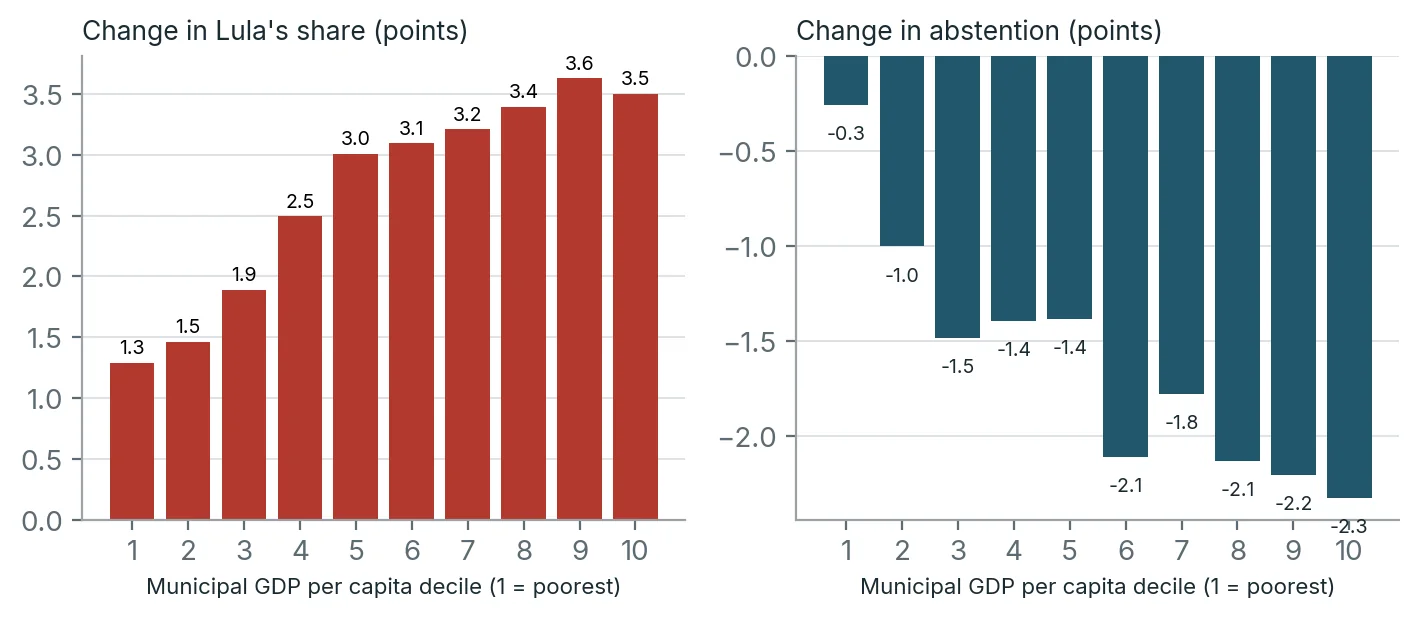
Income. In the poorest 10% of municipalities (median GDP per capita of R$ 11.4 thousand), Lula rose 1.3 points and abstention fell 0.3; in the richest 10% (R$ 95.1 thousand), he rose 3.5 points and abstention fell 2.3. The comeback came from middle- and high-income cities, not from Lula's strongholds.
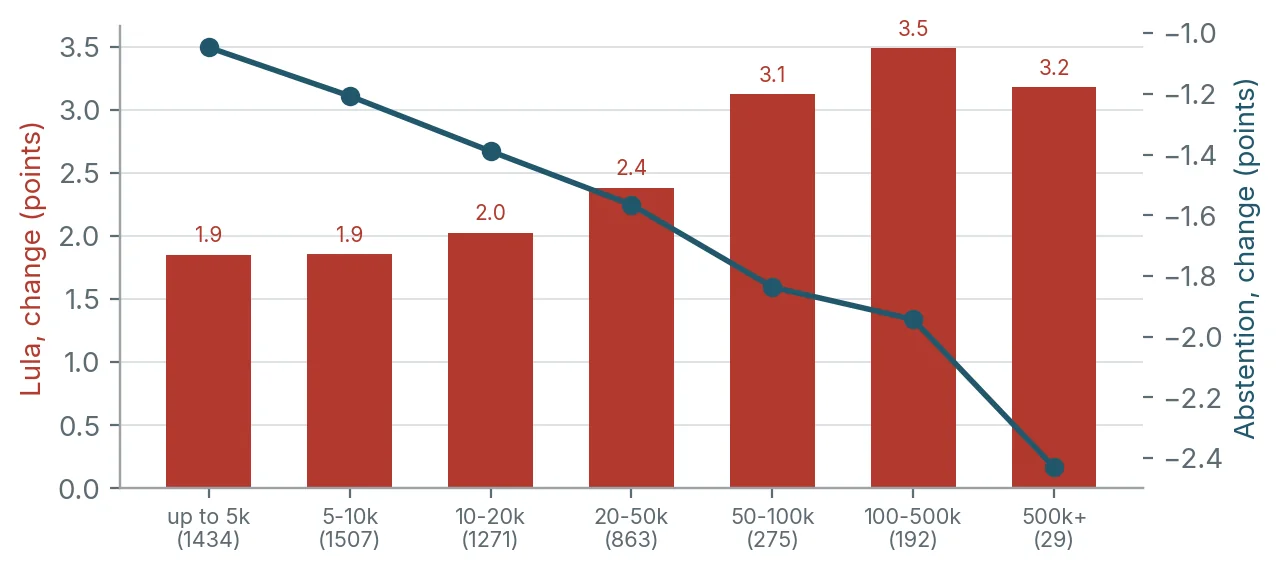
Size. Above 50 thousand voters: Lula +3.1 to +3.5 points and abstention −1.8 to −2.4. Up to 10 thousand: +1.9 and −1.1 to −1.2.
Caution. Municipal data, not voter data. GDP 2023 (IBGE) over 2024 population.
V. Turnoutcalculated
Abstention fell most where only the presidential race was on the ballot
Abstention by region, first round and runoff (% of eligible voters).
Against the trend. Until 2018 abstention always rose from the first round to the runoff; in 2022 it fell 0.36 point. In 2026 it fell 1.86 points, to 19.22%, the lowest in a runoff since 2006.
No governor race, more voters. In the 21 states without a gubernatorial runoff (and abroad), abstention went from 21.20% to 19.23%. In the six with a governor race, from 19.68% to 19.14%. Those who came out to vote came for the presidential race.
The exception of the North. Abstention rose in Acre (20.4% to 26.1%), Amapá (17.4% to 25.5%) and Roraima (17.1% to 23.2%), and to a lesser extent in Amazonas, Pará, Tocantins, Maranhão and Rondônia. In six of them Flávio lost votes in absolute terms. The causes still need checking before any interpretation.
V. Turnoutcalculated
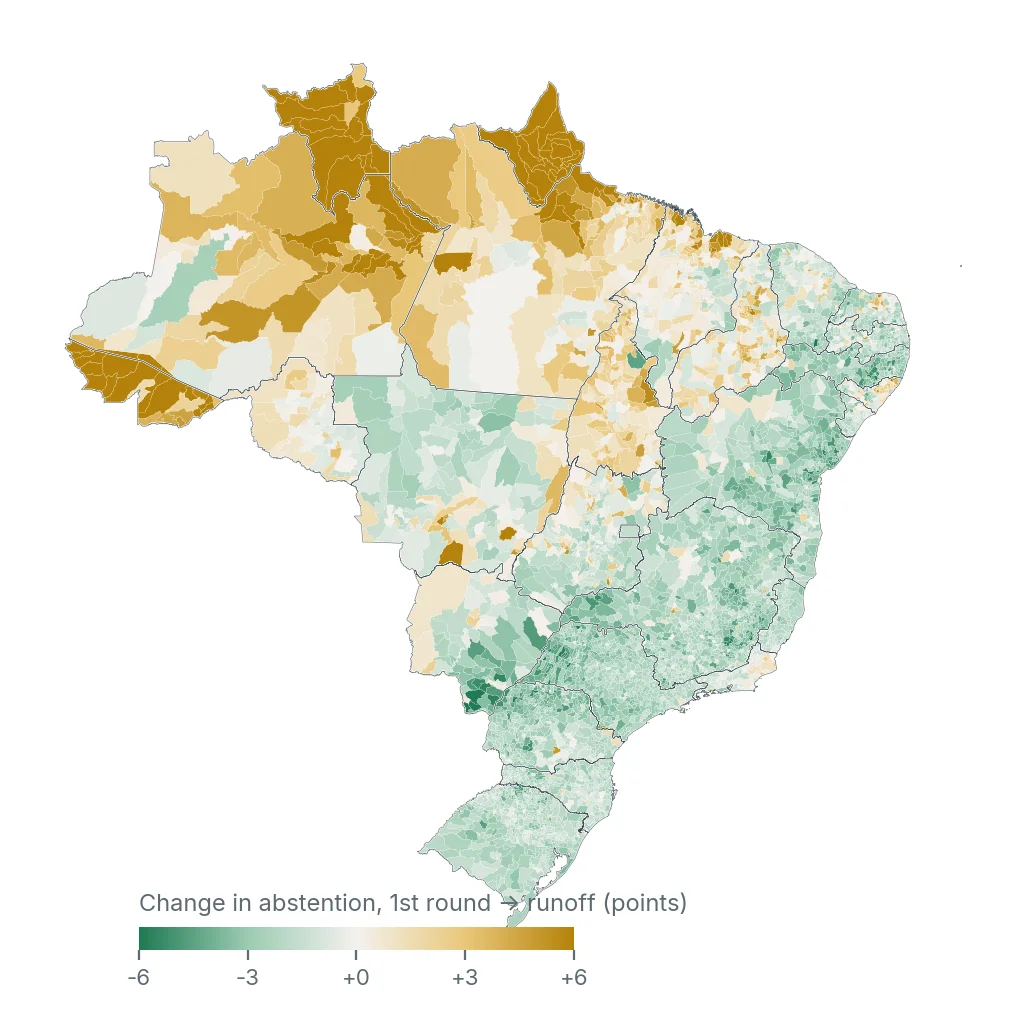
The abstention map: down in the Center-South and Northeast, up in the North
Green across the country, ochre in the North. Abstention fell in 4440 municipalities and rose in 1128. By state, the largest drops were in Bahia (−3.3 points), Pernambuco (−3.0), São Paulo (−2.7), Mato Grosso do Sul (−2.6), Paraná and Minas Gerais (−2.5); the increases, in Amapá (+8.1), Roraima (+6.0), Acre (+5.7), Amazonas (+1.5) and Pará (+1.2).
The North and logistics. These are municipalities with long distances and river transport, where voters living far from their polling station face a high cost to vote twice in three weeks. In the first round there was also the state race; in the runoff, only in AC, AM and TO.
In the rest of the country. The drop was larger where the race was more open and where only the presidential election was on the ballot, a pattern consistent with mobilization rather than with a state-campaign effect.
V. Turnoutcalculatedinterpretive
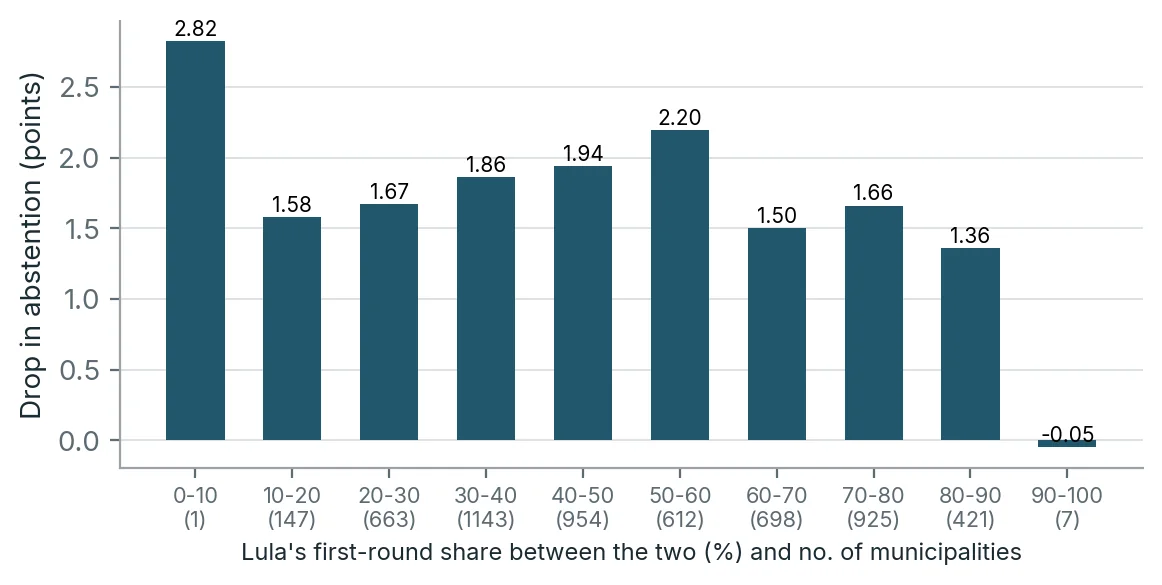
Mobilization test: abstention fell most in contested cities
Where it fell most. In the 40% to 60% bands of Lula's first-round vote, abstention fell 1.9 to 2.2 points. In Lula strongholds above 80%, only 1.4 points, and above 90% it was flat.
Flávio's strongholds. In municipalities where Lula had less than 10%, abstention fell 2.8 points, but Lula's gain there was 1.6 points: extra turnout in those places benefited both.
What this says. The mobilization that mattered was not in PT strongholds, already saturated, but in mid-table cities, which concentrate voters and where each additional voter moves the margin.
Aggregate change in abstention by band of Lula's first-round share between the two; number of municipalities in brackets.
V. Turnoutcalculated
Flávio's ceiling: where he lost votes
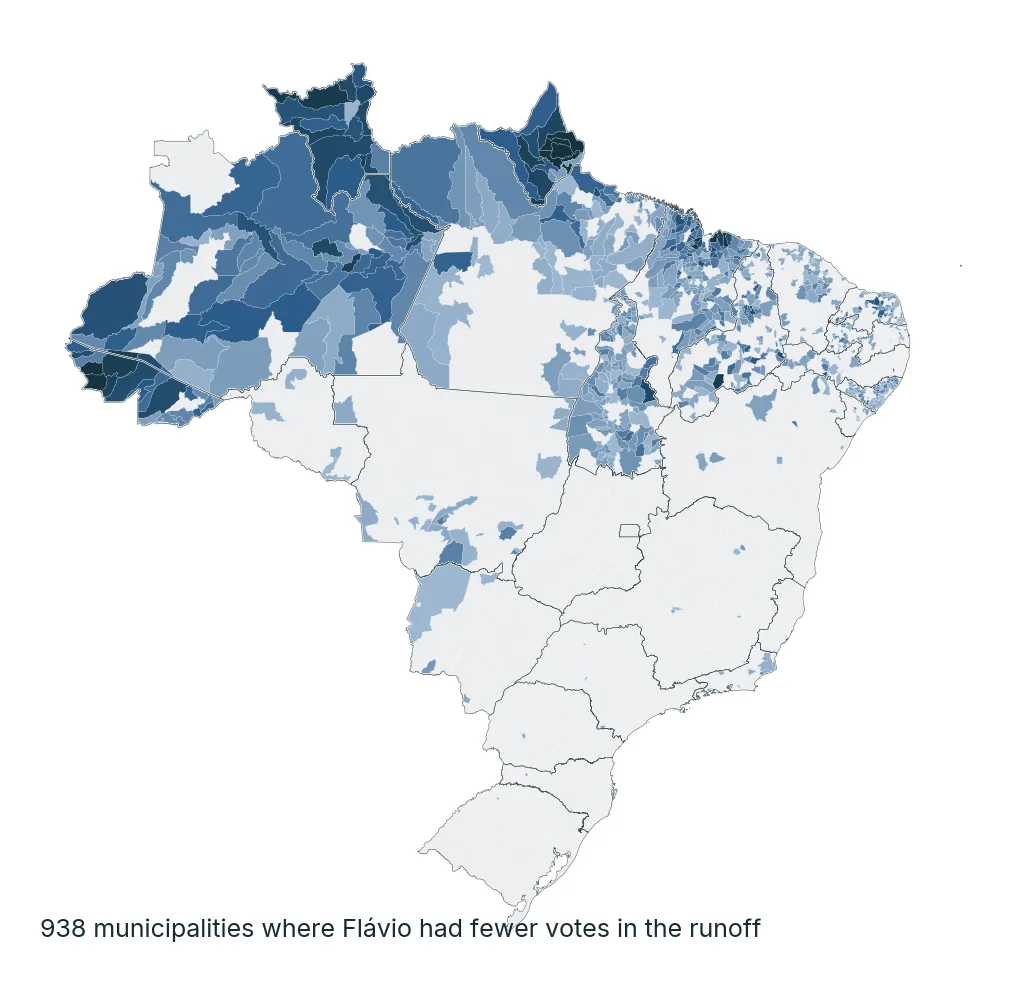
938 municipalities. In 938 municipalities Flávio had fewer votes in the runoff than in the first round; Lula, in 79, almost all in Acre, Roraima and Tocantins, where turnout fell.
Concentration. The blue patch covers the North and Maranhão, where turnout fell. The loss was small in votes (52 thousand in the six states where it fell), but shows he did not broaden his base where he needed to compensate. He grew in São Paulo (+1.22 M), Minas Gerais (+0.46 M), Paraná (+0.35 M), Rio Grande do Sul (+0.30 M) and Goiás (+0.29 M), always less than Lula.
State where Flávio lost votes
1st round
Runoff
Change
Acre
302,807
287,715
-15,092
Amapá
212,278
198,674
-13,604
Roraima
231,322
219,675
-11,647
Maranhão
1,239,040
1,229,971
-9,069
Amazonas
976,764
975,245
-1,519
Tocantins
469,321
467,916
-1,405
Contrast. In Luís Eduardo Magalhães (BA), the town in Nikolas Ferreira's video, Flávio grew 3.1% and Lula 22.6%.
VI. Mobilization, social media and voter travelreported
Lula's change of course after October 4
Digital mobilization. André Janones's WhatsApp channel passed 10 million followers and handed out daily tasks. The channel was frozen by a decision of the TSE president and restored by the electoral inspector-general the same day.
Political core. Rafael Fonteles (re-elected governor of Piauí) took over communications; Camilo Santana joined the coordination with Edinho Silva, focused on mayors and committees. There was public friction around the president.
Real-life agenda. The Senate approved the end of the 6x1 work schedule; the government announced free public transit and an expansion of Pé-de-Meia. The campaign asked activists to reach out to the elderly and those who did not vote in the first round.
What the result supports. The declared bet on converting absentees shows up in the numbers: 2.96 M more voters and a larger drop in abstention where there was no state race. It is consistent with the Vira Voto thesis (territory and turnout above persuasion), still as an association.
What remains to be measured. With polling-station data it will be possible to see whether turnout grew more in stations with higher first-round votes for Lula, the direct test of the strategy.
Source for the campaign reconstruction: Ranking dos Políticos, runoff results, and reporting from October 25 and 26.
VI. Mobilization, social media and voter travelreported
The race was also fought in WhatsApp channels, and Lula's nearly tripled
WhatsApp channel followers, in millions, according to counts published by Metrópoles, Brasil 247 and Poder360 between 12 and 24/10. Points without data were omitted.
The two armies. Janones's channel went from 3.7 M followers on 12/10 to more than 10 M on the eve, with daily tasks (sharing videos, pushing topics on X, guiding searches, calling rallies). Tropa do Flávio, created on 6/10 by Nikolas Ferreira with guidance from Gustavo Gayer, went from 1.4 M to 2.1 M and also organized in-person activities.
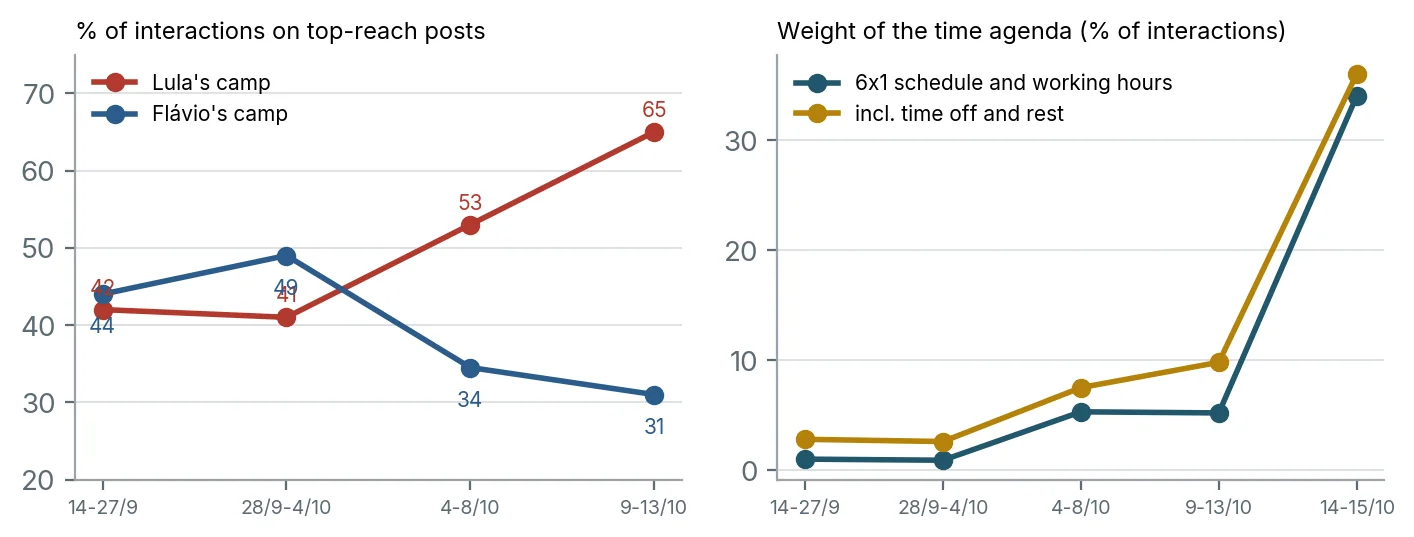
In the public conversation. In IPSE/Orikom monitoring, Lula's camp went from 41% to 65% of interactions between the eve of the first round and 13/10. Bites recorded a 22% rise in Lula's engagement with selfie-style videos, but also 46% negative mentions against 22.8% positive.
At the Electoral Court. The TSE president froze Exército do Lula at the request of Flávio's campaign; the inspector-general restored the channel the same day. A restriction on very large channels, discussed in the final stretch, would have hit both.
VI. Mobilization, social media and voter travelreported
The voters who crossed the country to vote
Bahia, free tickets
50 thousand+
Free intercity bus tickets issued to those who proved they were travelling to their polling place, 134% above the first round (21,344).
Transit voting
314,519
Voters authorized to vote outside their home municipality in the runoff, 52,206 of them in São Paulo. Requests closed on 20/08 and do not capture those who decided to travel later.
Free transport
all states
Free urban and metropolitan transit under a TSE resolution; several states opened free intercity travel from Friday to Monday.
Going home. On Friday and Saturday, bus stations such as Brasília's filled with voters heading to other states, above all in the Northeast; workers from Bahia employed in Pernambuco organized their return, some of them without having voted in the first round. On social media, showing the trip (by bus, boat, plane and even from abroad) became a trend, mostly among Lula voters, whose campaign targeted abstention.
Friction on Sunday. There were reports of reduced bus fleets and queues in São Paulo (about 60% of the fleet running, according to the petition taken to the Supreme Court), Salvador, Aracaju, João Pessoa and cities in at least seven states, which prompted the extension until 7 p.m. The disruption hit mostly poorer voters and those in the Northeast.
Sources: CNN Brasil, Terra, Rádio Senado, Brasil em Folhas, Portal Viggo, Brasil 247 and TSE (transit voting), 16 to 26/10.
VI. Mobilization, social media and voter travelcalculated
Where the 2.96 million additional voters appeared
Additional voters in the runoff compared with the first round, by region (TSE).
Region
Abstention in capitals (%)
Abstention inland (%)
Additional voters inland
Southeast
24.2 → 21.1
22.2 → 20.0
+1.12 M
Northeast
16.8 → 14.3
18.8 → 17.0
+616k
South
21.4 → 18.9
20.3 → 18.1
+448k
Center-West
19.2 → 17.7
23.1 → 21.4
+129k
North
17.6 → 18.4
20.2 → 22.5
−205k
The Southeast concentrated the mobilization. More than half of the additional voters (1.61 M) appeared in the Southeast, 932 thousand in São Paulo alone and 407 thousand in Minas Gerais, where the margin changed most. In the capitals of the Southeast and Northeast abstention fell more than inland.
The Northeast received those who came home. The inland Northeast had 616 thousand additional voters, Bahia alone 368 thousand. The results do not separate those who travelled from local residents; the free tickets indicate the return is a real but minority part of that number.
The North went the other way. Turnout fell in nine states (the seven in the North, Maranhão and Piauí), a total of 271 thousand fewer voters. Distance, rivers and travel costs are hypotheses to check.
Municipal association. The drop in abstention was slightly larger where it had been high in the first round (r = 0.15) and slightly smaller where Lula was stronger (r = −0.14): mobilization paid off more in contested cities than in strongholds.
VI. Mobilization, social media and voter travelinterpretive
What social media, mobilization and travel explain, and what they do not yet
Social media as a call to action, not just persuasion. According to the IPSE simulation, the message alone would shift about half a point. The result suggests another mechanism: channels and networks worked as a call to action (reminding people to vote, organizing trips, reaching the elderly), and the effect showed up in turnout, which the simulation treated as nearly neutral.
Turnout and valid votes combined. 4.78 M votes came in between those who started voting (2.96 M) and those who stopped annulling (1.82 M). By the ecological estimate, about two thirds of the new turnout went to Lula, worth close to 1 M votes of margin.
Why the polls missed it. Voters who decide to travel, or who skipped the first round and return for the runoff, are exactly the ones pollsters' turnout models tend to underestimate.
Flávio's side. Mobilization also existed on the other side (a channel with 2.1 M, battles over trending topics on X, rallies, formal support from Republicanos, Novo, União Brasil, PP and Tarcísio), but his growth between rounds (3.72 M) fell short even of the third-party votes (9.32 M).
What only polling-station data will tell. Whether turnout rose more in stations with higher first-round votes for Lula (the direct test of mobilization); how much of the increase inland in the Northeast came from people living elsewhere; how many voted after 5 p.m. and where.
A note of caution. Channel followers and interactions measure attention and engagement, not votes. The relationship between social media, travel and the result here is an association in time and territory, not demonstrated causation.
VII. Meta, debates and provocationsreported
Meta at the center of the race: failures admitted, interference denied
Date
What happened
7/10
A Lula video on Instagram shows more likes than views.
9/10
Lula's campaign goes almost 24 hours unable to boost feed posts; his profile did not appear in searches by name, while Flávio's showed up in suggestions.
11/10
PT files complaints with the TSE and the data protection authority (ANPD); Meta attributes the case to technical problems and the TSE gives it 48 hours to explain.
16/10
Meta admits failures that affected Lula's campaign, says Flávio's also reported problems and denies interference. The full TSE unanimously upholds a ban on limiting the reach of content from both candidates, under a daily fine of R$ 500 thousand.
19 to 23/10
Internal documents obtained by the NGO CTRL+Z point to six high-priority problems still open on Lula's account (search, comments, stories cut at 6 seconds, ads and AI-generated images).
20/10
Nikolas Ferreira's video about the Northeast loses its audio on Instagram over copyright; he alleges political motivation, without proof.
Meta's defense. Human review of automatic restrictions within two hours, equal criteria in Meta AI and election ads only from authorized advertisers. The company maintains that the reach of Lula's account stayed above its own baseline on the day of the counting glitch.
What is not known. There is no public measure of the effect on votes. The failures hit the tool Lula's campaign used most at the start of the runoff, and the response was to move the call to action to WhatsApp, where Exército do Lula grew from 3.7 M to more than 10 M.
The Electoral Court also became an issue. A Nexo survey using TSE data showed the court's president granting 17% of Lula's requests and 69% of Flávio's; the vice-president, 54% and 86%. Both sides used the figures as proof of bias.
Sources: Agência Brasil, DGABC, Tribuna de Minas, Times Brasil, Núcleo, SBT News and Nexo, 11 to 25/10.
VII. Meta, debates and provocationsreported
Two debates, two readings, and the polls did not move
Band, 18/10. First head-to-head of the campaign, after Flávio announced and then reversed his absence. It was marked by attacks and accusations: Lula linked Flávio to the 'Careca do INSS' case and called him a "clown"; Flávio cited suspicions against Lulinha and Roberta Luchsinger. Lula challenged him to open their bank and phone records. Afterwards he said the level was very low; Flávio celebrated his performance.
Globo, 23/10. Final debate, two days before the vote. For Antonio Lavareda, Lula won three of the four blocks and Flávio ended on the defensive; Jovem Pan commentators gave the win to Flávio, more restrained and proactive. Assessments followed each audience's leaning.
The measured effect. The Quaest poll of 23 and 24/10, partly conducted after the Globo debate, stayed at 51 to 49 for Flávio, the same as the previous round; only the share naming him as favorite fell (54% to 51%). Datafolha and PoderData repeated 51 to 49. Whatever the debate changed, if anything, did not show up in the polls.
Backstage. After the Band debate, Lucas Pavanato taunted Fernando Haddad ("Taxad", "fired") and got light slaps on the face; Nikolas Ferreira recorded a video calling Haddad and Simone Tebet "unemployed". Outside, Pavanato was heckled by Lula supporters.
Reading. Debates tend to reinforce more than convert, and this one was no exception in the polls. Their greater weight was as raw material for social media in the following days.
VII. Meta, debates and provocationsreported
Nikolas, Pavanato and Marçal: the provocations Flávio's camp did not control
Nikolas Ferreira. On 20/10 he published "The Northeast that was forgotten", with residents demanding Lula's promises; the video reached 160 M views on Instagram. Lula's allies alleged it was staged behind the scenes and responded with #NordestinosComLula. After the defeat, Flávio's allies began calling the strategy an "own goal" (Valdo Cruz, GloboNews).
Lucas Pavanato. The most-voted congressman in SP (3.04 M) starred with Flávio, in August, in the video portraying Lula as a criminal knocking on a car window (19 M views). In the runoff he taunted Haddad after the debate; during the count he mocked the "left's despair" and, once defeat was confirmed, called for the annulment of the election and the impeachment of Zanin.
Pablo Marçal. Joined the campaign at the end of the first round and coached Flávio for the Band debate. He told influencers to swap attacks for an "end of a cycle" message, acknowledging Lula's achievements; the campaign distanced itself from him after the debate. On the eve, he asked undecided voters for their vote, thanking Lula for what he had done and telling him to "go in peace".
Where the video was shot. In Luís Eduardo Magalhães (BA), Lula went from 20,173 to 24,739 votes (+22.6%) and Flávio from 38,496 to 39,688 (+3.1%); Lula's share rose from 32.5% to 38.4%. In Bahia, from 66.17% to 71.31%, and in the Northeast Lula finished with 24.45 M votes against 10.80 M.
Moderate or break, without choosing. Flávio's camp swung between confrontation (Nikolas, Pavanato, his posture at the Band debate) and moderation (Marçal, the tone at Globo), the dilemma IPSE pointed out on 15/10. The result in the Northeast is consistent with the reading that the provocation mobilized the opponent, but there is no way to isolate that effect.
Sources: Diário do Poder, Portal VV8, Folha PE, Imirante, Regionalzão, Plantão Brasil, Estado de Minas, Acorda DF, ND Mais, NC News, Pleno News, Gazeta do Povo, Metrópoles and Poder360, 25/08 to 26/10. Luís Eduardo Magalhães figures: TSE.
VIII. Pollsreportedcalculated
Almost every poll had Flávio ahead
The size of the error. On Lula's share of valid votes, the median error of the 19 polls was 2.8 points. The six from the final week missed by 1.9 to 2.8 points, 3.8 to 5.6 on the margin, all with the wrong winner.
Who came closest. Vox Brasil (5 to 7/10), with Lula at 50.9%, and Futura on the eve, with 49.9%. The largest error was Gerp's (8 to 12/10), 6.8 points. According to Poder360, of the 18 national polls from 12 to 24/10, only one showed Lula numerically ahead.
Reversed direction. In the first round, polls underestimated Flávio; in the runoff, they underestimated Lula. The RED aggregator, with 47 polls, estimated 50.92% for Flávio on the eve.
Hypothesis to test. The turnout the polls failed to capture is the strongest candidate to explain the error: 2.96 M more people voted, and the ecological estimate places most of them with Lula.
Sources: Maurício Romão's synthesis cited by IPSE (3 to 14/10) and final-week polls published by RED, Poder360 and TVT News.
VIII. Pollsreportedcalculated
The IPSE/Orikom model against the ballot box
What the 15/10 model said
What the ballot box showed
Lula at 48.0% in the median (80% range: 44.7% to 51.4%); victory in 23% of simulations
51.79%, above the range, in the 51% to 52% band, to which the model gave 6.6%
A comeback only with polls underestimating Lula by about 3 points
That is what happened: median error of 2.8 points
Abstention +0.5 point (−1.3 to +2.7)
−1.86 points, outside the range
States with a governor race hold 1 more point of turnout
The opposite
Turnout with a net effect of −0.1 M on the margin
New turnout of 2.96 M, about 2/3 for Lula (estimate)
Victory scenario: Southeast −3.4 M, Northeast +12.3 M
Southeast −2.81 M, Northeast +13.65 M
What is worth keeping. The thesis that communication alone would not turn the race is not refuted: what changed the picture was the polling error and turnout, the two factors the model left outside its core mechanism.
Early signal. On social media, Lula's camp went from 41% to 65% of interactions between the eve of the first round and 13/10, and the 6x1 work schedule reached a third of interactions on 14 and 15/10, when the Senate approved the constitutional amendment 75 to 1. Social media data moved toward the result before the polls, which strengthens the anticipation hypothesis without proving it.
Social media data from the Orikom platform (IPSE Global); intermediate points read from the chart in the 15/10 study.
IX. The extension and the challengereported
What is known about the extension until 7 p.m.
The decision. Lula's coalition asked the Supreme Court (STF) for an extension due to a lack of buses in municipalities in Bahia and São Paulo; Justice Cristiano Zanin, drawn as rapporteur, extended voting until 7 p.m. at all polling stations in the country, with the TSE to implement it. Flávio's campaign had also asked the TSE for an extension in municipalities of SP, PR, MG, RS and SC, citing the weather.
Implementation. An arrangement between Zanin and the TSE president, Kassio Nunes Marques, limited the extension to stations still open, since those already closed could not reopen. The TSE paused the release of results at 5:20 p.m. and began measuring the impact, with no deadline.
Flávio's challenge. He does not recognize the result and announced a request for annulment. Arguments: a change of rules during voting, broken equality between voters in different states, the jurisdiction of a Supreme Court justice rather than the TSE, Zanin's alleged bias (former lawyer for Lula) and the removal of PL observers from the counting room.
The order of magnitude. The final margin is 4,430,191 votes. To change the result, stations that stayed open after 5 p.m. would have had to give Lula, in that window alone, more than 4.4 M net votes. The first polling-station measurement, on the next page, shows that the balance in those stations is small.
On the institutional side. Supreme Court and TSE justices, according to CNN, rule out annulling the election.
IX. The extension and the challengecalculatedestimated
First measurement: the polling stations that stayed open after 5 p.m.
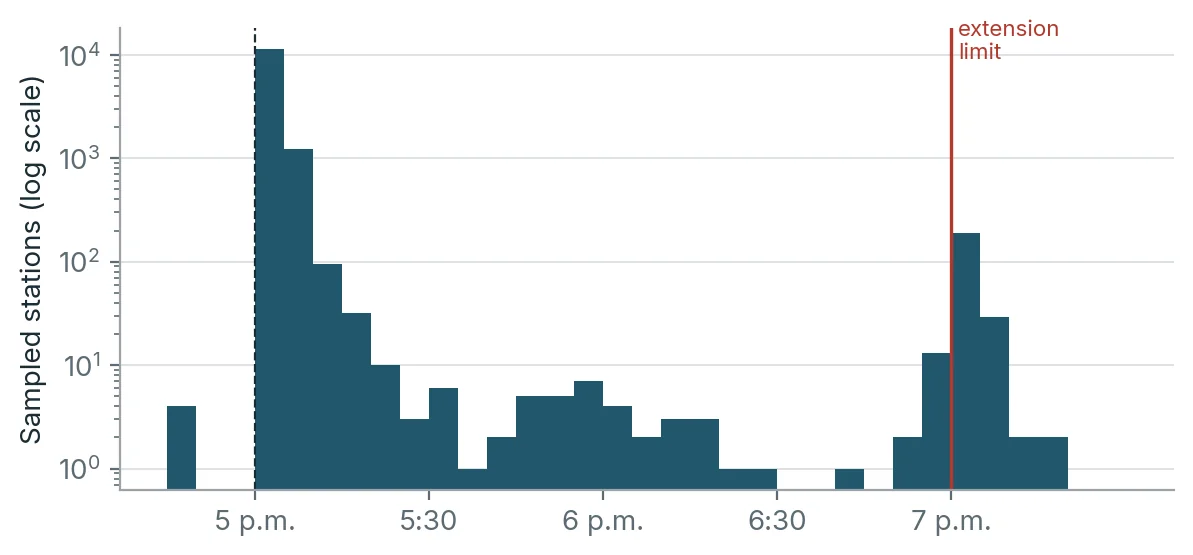
Closing time (Brasília time) of 10,241 sampled polling stations, read from each station's tally report. Logarithmic scale.
State
Stations in sample
Closed after 5:30 p.m.
After 6:30 p.m.
Voters in those stations (estimate)
Lula's margin in them (estimate)
SP
4,147
2.1%
1.6%
579,975
+74,500
MG
2,095
0.0%
0.0%
0
0
RJ
1,506
8.1%
7.2%
895,600
−65,100
BA
1,411
2.8%
2.6%
291,500
+116,250
PR
1,082
0.0%
0.0%
0
0
Systematic sample of 1 in every 25 polling stations, with TSE tally reports (election 3221). Estimates multiply the sample by 25. Voters and margin cover the whole day at those stations, not just the period after 5 p.m.
Method. Each station's tally report records opening, closing, turnout and votes. Sample processed: SP, MG, RJ, BA, PR. The other states are still missing, including PE, SE, PB and PI, where transport complaints arose.
What the sample shows. The vast majority of stations closed between 5:00 and 5:10 p.m. Stations that stayed open after 5:30 p.m.: 8.1% in Rio de Janeiro, 2.8% in Bahia and 2.1% in São Paulo; in Minas Gerais and Paraná, no sampled station closed after 5:10 p.m. In the stations that stayed open, Lula had more votes over the day in São Paulo and Bahia; Flávio, in Rio de Janeiro.
The order of magnitude. Adding up the full-day margin in the stations that stayed open after 5:30 p.m., the estimated balance is +125,650 votes for Lula, 2.8% of the national margin. Even if all of it came from the extension, Lula would remain ahead by more than 4.3 M. The five states measured account for 52% of the electorate.
X. The power that comes out of the ballot boxcalculated
The presidency for Lula, Congress for the PL
Governors elected in the runoff
Valid votes
Acre: Mailza Assis (PP)
66.21%
Amazonas: Omar Aziz (PSD)
61.42%
Distrito Federal: Celina Leão (PP)
57.18%
Espírito Santo: Lorenzo Pazolini (Republicanos)
52.17%
Rio Grande do Norte: Cadu de Lula (PT)
50.77%
Tocantins: Vicentinho Júnior (PSDB)
64.52%
Rio de Janeiro: Douglas Ruas (PL), by recount of the first round
50.88%
In RN, Cadu de Lula won by about 32.6 thousand votes. In DF, Flávio had 54.28% for president and Celina 57.18%.
Congress. The PL will have 121 deputies and 28 senators, the largest caucus in both houses. The government's base in the Senate falls from 38 to 26.
Senate 2027 update. With Omar Aziz becoming governor of Amazonas, his first alternate, Cheila Moreira (PT), takes his seat: PT goes from 9 to 10 senators and PSD from 5 to 4. Alan Rick and Professora Dorinha lost and remain in the Senate.
First battle: February 2027. In the Senate, Davi Alcolumbre seeks re-election weakened, and the PL needs at least 13 votes from outside to reach 41. In the Chamber, Hugo Motta is the favorite.
XI. Repercussionreported
How the international press read the comeback
United States. The New York Times highlighted the rejection of the predecessor's son and recalled Zanin's extension. The Washington Post read the victory as a brake on Latin America's turn to the right and pointed to Jair Bolsonaro's government as the driver of voter mobilization in recent weeks.
Europe and the Middle East. The Guardian called the fourth term historic after a dramatic reversal; the BBC stressed that Flávio had won the first round; Reuters, that the result defied the latest polls; Al Jazeera spoke of a shocking turnaround.
Argentina. La Nación described the day as controversial because of the extended hours and noted that Flávio does not recognize the result; Clarín, the margin of about three points; Página 12, the limits on public transport.
Reading. Abroad, three themes dominate: the unprecedented comeback, the polling error and the challenge. The third is the one that may gain ground in the coming weeks, which is why the polling-station study of the extension also has external value.
Annexcalculated
Table by state: votes, margins and turnout
State
Lula R1 (%)
Lula R2 (%)
Lula R2 (votes)
Flávio R2 (votes)
Margin R1
Margin R2
Margin gain
Abst. R1 (%)
Abst. R2 (%)
Additional voters
São Paulo
38.2
46.2
12,119,274
14,139,178
−3,416,610
−2,019,904
+1,396,706
22.5
19.8
+932k
Minas Gerais
43.3
50.4
6,351,099
6,241,786
−588,612
+109,313
+697,925
22.8
20.3
+407k
Rio de Janeiro
39.4
46.9
4,565,393
5,169,033
−1,273,823
−603,640
+670,183
23.3
21.6
+218k
Bahia
66.2
71.3
6,485,258
2,608,761
+3,222,186
+3,876,497
+654,311
20.0
16.7
+368k
Paraná
31.2
37.4
2,566,504
4,291,444
−1,890,748
−1,724,940
+165,808
20.6
18.0
+218k
Rio Grande do Sul
35.7
42.2
2,824,552
3,874,378
−1,279,024
−1,049,826
+229,198
21.4
19.2
+187k
Pernambuco
63.5
69.2
4,117,513
1,832,554
+1,815,928
+2,284,959
+469,031
18.2
15.2
+215k
Ceará
63.3
68.9
4,036,124
1,819,478
+1,798,413
+2,216,646
+418,233
15.5
13.9
+114k
Pará
49.9
55.0
2,690,449
2,199,940
+263,280
+490,509
+227,229
19.1
20.3
−77k
Santa Catarina
25.0
30.6
1,418,314
3,220,071
−1,872,852
−1,801,757
+71,095
18.9
17.0
+114k
Maranhão
64.0
69.5
2,808,231
1,229,971
+1,327,261
+1,578,260
+250,999
19.7
20.4
−33k
Goiás
31.1
40.3
1,585,555
2,345,334
−863,008
−759,779
+103,229
21.8
20.3
+76k
Paraíba
61.3
67.5
1,794,059
865,210
+709,750
+928,849
+219,099
17.4
15.5
+60k
Espírito Santo *
37.8
43.6
1,001,965
1,294,504
−383,166
−292,539
+90,627
21.4
19.5
+57k
Piauí
71.0
75.9
1,653,989
525,859
+1,006,682
+1,128,130
+121,448
17.2
17.2
−1k
Rio Grande do Norte *
59.8
65.7
1,413,596
737,409
+517,470
+676,187
+158,717
18.4
16.1
+62k
Amazonas *
48.2
54.0
1,145,783
975,245
+70,232
+170,538
+100,306
20.2
21.7
−42k
Mato Grosso
29.2
33.9
694,167
1,351,099
−716,900
−656,932
+59,968
22.2
20.9
+33k
Alagoas
54.7
60.8
1,152,621
744,140
+259,741
+408,481
+148,740
20.6
20.1
+13k
Distrito Federal *
38.1
45.7
825,224
979,542
−233,989
−154,318
+79,671
18.9
17.3
+37k
Mato Grosso do Sul
34.7
40.4
628,973
927,892
−356,496
−298,919
+57,577
23.9
21.2
+53k
Sergipe
62.7
69.5
989,041
433,354
+438,180
+555,687
+117,507
17.3
15.7
+28k
Rondônia
25.9
30.4
294,446
674,382
−402,321
−379,936
+22,385
21.7
21.9
−3k
Tocantins *
43.4
48.6
442,962
467,916
−65,312
−24,954
+40,358
18.3
19.2
−10k
Acre *
28.7
33.4
144,513
287,715
−168,037
−143,202
+24,835
20.4
26.1
−35k
Amapá
45.7
52.9
222,968
198,674
+225
+24,294
+24,069
17.4
25.5
−47k
Roraima
22.9
27.5
83,505
219,675
−156,902
−136,170
+20,732
17.1
23.1
−24k
Lula first round over all valid votes. Margin: Lula − Flávio, in votes. * Gubernatorial runoff. Source: TSE, 100% counted.
Integrity notes
Measures, sources and what is still missing
Labels.calculatedcomputed by Henrichs from official data; anyone can redo it. estimatedofficial data with an assumption along the way, stated in the section. reportedinformation from the press or third parties, with the source cited. interpretiveHenrichs' reading of the data, not a measurement.
Measures. Percentages over valid votes. "Margin" is Lula minus Flávio, in votes. Municipal flips count only actual winners (first-round ties aside). The municipal margin improvement and the swing use Lula's share between the two candidates. Income deciles and size bands aggregate votes before computing the change. Maps: margin and changes by municipality; labeled colors in every legend. The ecological model (regression without intercept of the change in votes on third-party votes, turnout and invalid votes, by municipality) indicates association, not individual behavior.
Correction. The first reading of 25/10 cited 15 × 13 states in the first round and 14 × 14 in the runoff; the correct figures are 15 × 12 and 14 × 13 (votes abroad had been counted as a state).
Sources. TSE, official results (elections 6257 and 6258) and tally reports (election 3221, sample of 1 in 25 stations). IBGE: municipal GDP 2023 (table 5938) and estimated population 2024 (table 6579). Municipal boundaries: geodata-br, with 5,564 municipalities (six created after 2013 lack a polygon but are included in all calculations). Ranking dos Políticos, runoff results. IPSE/Orikom, Does Lula turn it around and win the runoff?, 15/10. Reporting by g1, O Globo, Poder360, Metrópoles, Nexo, Núcleo, Agência Brasil, Folha PE, Gazeta do Povo, Estado de Minas, Jornal de Brasília, CNN Brasil, Terra, Rádio Senado, Exame, InfoMoney, Brasil de Fato, Brasil 247, Brasil em Folhas, Portal Viggo, Tribuna Online, DOL and SBT News, 16 to 26/10; TSE (transit voting). The g1 and O Globo pages could not be opened due to access blocking; their data were checked through reproductions and against the TSE database.
Pending. Time measurement in the remaining states and votes cast after 5 p.m. from the voting logs; turnout by polling station against Lula's first-round vote; weight of voters who travelled; comparison with 2022 by municipality; checking the swing cities against 2018 and 2022; causes of abstention in the North; voting by neighborhood and school.
Reproduction allowed with attribution: Henrichs Consultoria · henrichsconsultoria.com.br